
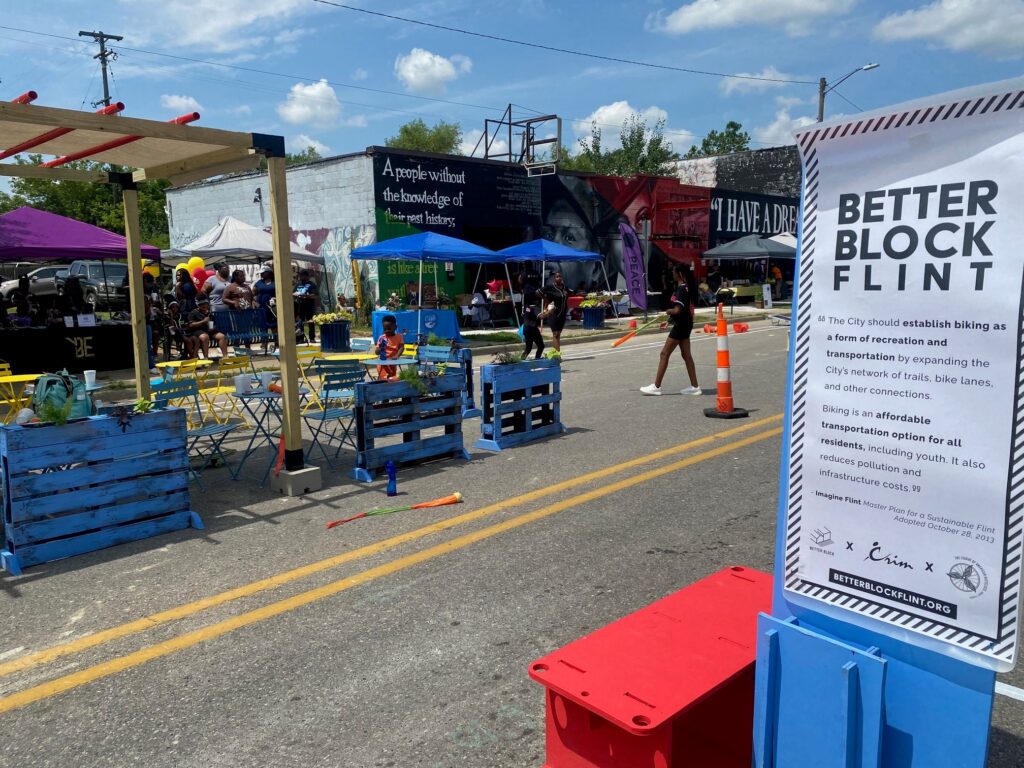
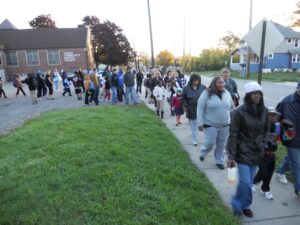
Since 2008, Crim Fitness Foundation (Crim) has provided Safe Routes to School (SRTS) programming in Flint, Michigan. What began as a way to increase the number of people walking and biking in the community, their SRTS programming and role in the community has evolved.
Crim Director of Urban Strategies Cade Surface implements changes involving the built environment across the City of Flint. Through this role, and others he previously held at Crim, Surface has always been involved in Flint SRTS projects.
“In my former position as an intern, my primary responsibility was to set up walking school bus events and direct education programs,” said Surface.
In this role, he saw a kernel of opportunity to move beyond events and programs to impact the built environment to better support active transportation. Crim leadership agreed, and they began to expand on what they wanted to achieve as an organization, which was to continue to increase the number of people walking and biking and to create spaces where people would be able to use active transportation safely.
“Now my work focuses on the way in which things are built, the policies that control how they are built, and how people move through those spaces,” Surface explained.
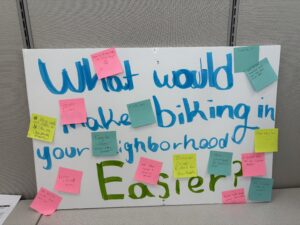
Across Flint, there are many neighborhoods that are low- and middle-income surrounded by blight, abandonment, and disinvestment. Surface explained that understanding the history and context of Flint’s neighborhoods is relevant to community engagement within the city, an important aspect of the overall planning process. Also, understanding the unique needs of neighborhoods informs Surface’s approach when leading community engagement in Flint. For example, some neighborhoods get more involved in the planning process, though they may not be representative of the entire ward. Surface is always looking to balance the information he receives to ensure more voices are considered in the planning process.
Surface shared one of his approaches to community engagement that helps to inform Crim’s SRTS programming.
“My approach is to work in tightly defined geographic zones with a specific center and edge,” said Surface. “And by talking only with people who live, work, or are otherwise deeply associated within that geographic zone., In this way I am able to engage closely with the people living in the neighborhood to learn their specific needs.”
Because his work is tailored to each neighborhood, as opposed to something generic that may or may not work in multiple places, the residents have buy-in and are more empowered to support his work.
“We treat people as experts of their day-to-day life – without asking them to be experts on the lives of people ten blocks away or topic area experts in design, engineering, transportation, or anything else,” said Surface. “These methods help ensure engagement efforts get to the heart of an issue and don’t limit the possible outcomes.


As Crim’s SRTS programming has progressed to the built environment, the role of Crim, and their role within the City of Flint has evolved.
“The safety of kids trying to get to school has become a much more three-dimensional conversation and allowed the general active transportation movement to be recognized in Flint,” stated Surface.
Surface shared that Crim was part of the City of Flint’s 2013 Master Plan update, which allowed them to lay out some general recommendations for land use changes, and after ten years, the changes were integrated into the local ordinances.
Surface explained that making land use changes and expanding development, amenities, and safety along school routes encourages students and their families to use them more. Doing this maximizes the effectiveness of established SRTS infrastructure projects.
“Developing existing school routes is essential and ensures the city can manage for the infrastructure in the long-term, without having to rely on SRTS program grants,” explained Surface.
Led by the early and ongoing efforts of Crim, the City of Flint now incorporates Safe Routes to School as an integrated function of its operations and inserts it within its Imagine Flint Comprehensive Plan.
The integration of SRTS into the Imagine Flint Comprehensive Plan would not have happened without the successful collaboration between Crim, Flint residents, and City of Flint.
“The success we’ve achieved through SRTS programming required vision, patience, and a long game approach,” said Surface. “While there is always more work to do, I can’t think of another program that would have facilitated so much positive change across the community more.”
Summary of SRTS Flint Project Impacts
The City of Flint has received six major grants from 2008 to 2020.
- MDOT/SRTS Total Infrastructure Total Budget: $3,246,303
- MDOT/SRTS Infrastructure Preliminary Design Budget: $201,464
- MDOT/SRTS Infrastructure Construction Budget: $3,044,839
- MDOT/SRTS Major Grant Non-Infrastructure Total Budget: $79,695
Further, there have been 10 mini grants to support SRTS programming. Crim has also provided capacity and expertise for SRTS planning efforts to other regional stakeholders within Genesee County.
Safe Routes to School projects and programs were made possible through the continuing collaborative efforts of the City of Flint, Flint Community Schools, Crim Fitness Foundation, Michigan Fitness Foundation, Michigan Department of Transportation, and Federal Highway Administration.