
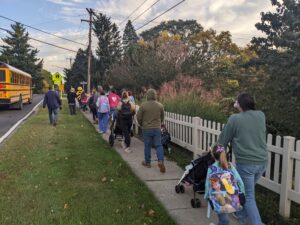
The Bath Township Safe Routes to School (SRTS) project improved connectivity, walkability, and safety for students on their school commute. The project was funded through a SRTS major grant, and to achieve active transportation goals, a comprehensive group of community members and stakeholders was formed. Stakeholders included Bath Community Schools, Bath Township, Clinton County Road Commission, Michigan Department of Transportation (MDOT), and Michigan Fitness Foundation’s (MFF) SRTS team.
To create a successful SRTS project, project teams use people-focused approaches that center users in engagement, design, implementation, and assessment. The Bath Township SRTS team included Bath Township community member Chris Hagerman, Clinton County Road Commission’s former Director of Engineering Marc Trotter, and Bath community member Elise Erickson, along with staff from MDOT and MFF.
“My job was as point of contact for the whole project, to get folks involved, and to organize the meetings,” explained Hagerman, who acted as SRTS chairperson.
“I presented the idea of the SRTS grant to the Bath Township Board of Trustees to convince them it was a beneficial project for the community. The board of trustees provided funding to allow the project to move forward. The project encouraged the board of trustees to repair and construct new sidewalks in the areas included in the grant, and update their sidewalk policy,” furthered Hagerman.
To get people involved, Hagerman helped organize and motivate volunteers.
“Many people said, ‘I don’t feel like I can contribute,’ but I promoted that even if you help with one small thing, it takes the workload off somebody else. That even small contributions would help to make a big difference – people bought into it,” explained Hagerman.
The team began with a walking audit, which is a community-led assessment of street infrastructure to identify hazards and safety improvements for the project. During the walking audit, it became clear to everyone that there were inconsistencies with the sidewalk infrastructure. This led them to focus on constructing new sidewalks in neighborhoods on public right of ways to improve connections for students to Bath Community Schools.
“Some people were concerned about the impacts on their personal property with the new sidewalks – I let them know the township was willing to personally work with each one of them to find a solution,” shared Hagerman.
Clinton County Road Commission was the Act 51 administering agency for the project. The Act 51 agency holds the authority over the public right of way on local roads and therefore must approve of any road construction and provide a letter of support. Though, in this project, the road commission was more involved. Former Clinton County Road Commission Director of Engineering Marc Trotter led the actual design and construction processes. He also oversaw the consultant’s design work and coordinated planning with the school system and township.
“The SRTS infrastructure funding came through our agency for construction,” said Trotter. “I also sat in on some of the planning and surveying in the engagement process,” said Trotter, “When we did the community walk audits, we got input of needs and desires for the project. It was nice to be part of that end, so once it came to us to build, I understood the background.”
Through the audits, the residents pointed out active transportation was lacking and the connections between Hunters Crossing subdivision and an apartment complex to the schools in the town center was unsafe.
“Hunters Crossing is on a busy road and people drive fast. The gap between the subdivision and the nearest sidewalk is maybe a thousand feet. There is a pond and no shoulder,” Hagerman said.
“Hunters Crossing is on a busy road and people drive fast. The gap between the subdivision and the nearest sidewalk is maybe a thousand feet. To get to another sidewalk from the Hunters Crossing Subdivision resident would have to walk along a road that had no shoulder and past a pond that goes up to the edge of the road”, Hagerman said.
To address this, the gap needed to be closed, and a sidewalk needed to be constructed to make it easier for people to access the school and town center from their neighborhood.
“It’s just the challenge of getting through construction. That’s something that we’re good at,” said Trotter.
Working hand in hand with township officials to move through project challenges together strengthened relationships between the County Road Commission and the township, and benefited Township residents.
“There were people in adjacent apartment buildings that never had a connection into town. And a day after we poured concrete, there were people using that sidewalk,” added Trotter.
“People are very appreciative of having the sidewalk at Hunters Crossing now, so I know it impacted that subdivision significantly,” said Hagerman.
Another portion of the route was designed to go through James Couzens Memorial Park, a historic property in town that is home to the 1927 Bath School Memorial, State Historical Marker, and Veterans Memorial. As a federally funded project, the project was subject to review under Section 106 of the National Historic Preservation Act of 1966 (NHPA) to determine potential to affect historic properties. Special consideration was given to the work at the James Couzens Memorial Park because of the historical significance of the site.
To work through the Section 106 process, Bath partnered with MDOT. Working with an MDOT staff archeologist and historian, they were then able to thoughtfully address sidewalk gaps through the town center and avoid adverse effects to the historic site to move the project forward.
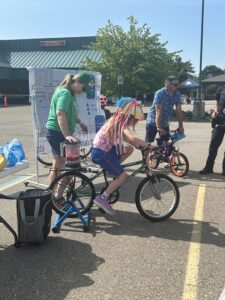
To encourage use of the new community infrastructure, Elise Erickson coordinated educational programming on behalf of Bath Community Schools for students, their families, and the larger Bath community.
“I acted as middleman between the SRTS grant programming and the community,” said Erickson.
To increase SRTS program participation, she worked with the community and managed community events, like a bike rodeo. A bike rodeo is a fun, safe event where elementary and middle school students learn and practice bike-handling skills. Volunteers guide kids through chalk-marked courses and cone obstacles designed to teach better bike control.
“One big connection was the Bath Township Public Library because they serve and are supported by the community,” stated Erickson.
Erickson worked with the library on a The StoryWalk®, which is an outdoor, interactive literacy activity where pages of a children’s book are mounted on signs along a path, allowing families to read, walk, and engage with a story in nature
By coordinating with the community, the events were well attended, successful, and raised awareness for the new sidewalks and SRTS project. Additionally, each member of the SRTS project team was involved in community engagement efforts which built relationships and trust between entities.
Through early coordination, community connections, dedicated stakeholders, and strong support from local and state agencies Bath Township overcame obstacles that helped them achieve their SRTS project goals.
“Don’t be hesitant or avoid a combined sidewalk project. There are challenges, but in the end, it is worthwhile,” Trotter advised.
Project Summary
This project filled sidewalk gaps in the town center of Bath Township. Among these, it created connections to a far-out subdivision and an apartment building which never had any pedestrian connection before.
- Total SRTS Grant Amount: $501,456
- Local Match Amount: $125,364
The project was made possible through the collaborative efforts of Bath Community Schools, Bath Township, Clinton County Road Commission, Michigan Fitness Foundation, Michigan Department of Transportation, and Federal Highway Administration.