
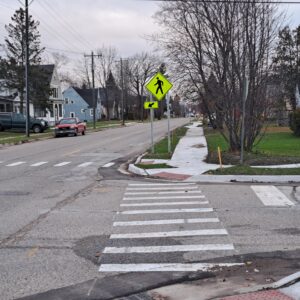
By partnering with community members and stakeholders, the City of Sault Ste. Marie and Sault Ste. Marie Area Public Schools led consistent community engagement for the Sault Ste. Marie Safe Routes to School (SRTS) project.
The project was created to improve walkability and increase sidewalk use throughout the community, benefiting students at Lincoln Elementary, Washington Elementary, and Sault Area Middle School.
However, the SRTS planning team had to be flexible, because the school district had a reconfiguration that would be implemented between the planning process and construction. An elementary building was closed, bringing all district eligible students to the two remaining city elementaries. Further, the remaining elementaries which had previously served as neighborhood schools for k-5 graders were changing to serve specific grade ranges for the whole district. The students housing maps of the reconfiguration showed students coming from further distances and possibly more trips from families to get everyone to school since children would be split across different buildings based on their grade.
The city’s engineering department played a key role in the project, including City Engineer David Boyle, Staff Engineer Morgan Buckmaster, Engineering Technician/GIS Specialist Joe Miller and Engineering Project Specialist Tracey Laitinen. The project team also received planning and technical assistance from Michigan State University (MSU).
“There were some gaps in the sidewalks and general pedestrian infrastructure. People needed connections between point A and point B,” Buckmaster said.
The school effort was spearheaded by Sault Area Middle School Principal Jessica Rondeau, with support former Superintendent Timothy Hall, and now current Superintendent Amy Scott-Kronemeyer.
“I was tasked with spearheading our SRTS committee to look at infrastructure in our community, specifically around school sites,” Rondeau said.
The project team prioritized community engagement across both the city and the school district.
“We always do a preconstruction public meeting for all of our projects. That is a standard for us,” Buckmaster said.
During public meetings, they would address as much as possible about the project, though they’d also follow up personally with residents after the meetings to address any additional questions.
After gathering feedback, the engineering department worked to accommodate concerns through design adjustments and field modifications.
“We did weekly project updates where we shared what we accomplished the past week and what we had planned for the next week. We also told residents what to expect and encouraged them to call us with any concerns,” she explained. “We also used door hangers to notify residents at their homes ahead of time when we were pouring concrete.”
“There were a lot of concerns from residents who wanted sidewalks adjusted to accommodate trees, benches or other obstacles within the right of way. So, when we got out there, we did a lot of field fitting,” Buckmaster said.
During the course of the project, Superintendent Timothy Hall retired and Amy Scott-Kronemeyer was appointed as the new superintendent.
“Anytime there are changes among key members of a committee, it can affect project completion,” Rondeau said. “I think the greatest factor we had going for our team was keeping clear and detailed notes from meetings, emails, and all correspondence,” Rondeau furthered. “You need systems in place to maintain momentum and preserve the full body of work. That is paramount to success.”
Because the team was organized and committed to meeting the grant deadline, onboarding the new superintendent didn’t derail the project.
“I shared resources, specifically the site specific spiral bound recommendations from our SRTS team at MSU. I also shared my notes from the projects and had conversations about next best steps with the incoming superintendent. I was fortunate that she had a high level of awareness already – I was filling in gaps,” said Rondeau.
After construction was completed, the city and school district saw positive outcomes for students and the broader community.
“We installed rapidly flashing beacons at one of the busier intersections,” Buckmaster said. “Within the first week of school, the principal emailed us and said it was great to see people actually using them.”
Another key achievement for the city was meeting accessibility goals.
“Achieving ADA compliance was huge because much of the infrastructure here in the Soo is aged,” Buckmaster said.
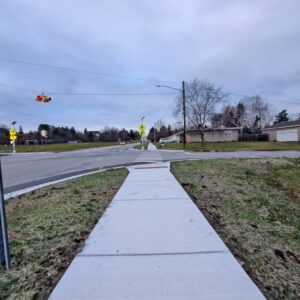
Rondeau said the benefits extend beyond student safety, improving quality of life for the entire community.
“Anytime you improve community infrastructure, it adds value,” she said. “It benefits everyone, from property values to overall safety… that’s a win and it’s worthwhile. I see the benefits across the community, not just for students walking or rolling to school,” she added. “I see parents with strollers, people using wheelchairs or knee scooters. This wasn’t just about safe routes to school; it was about creating a safer community.”
Project leaders said the effort ultimately achieved its goals and has made a lasting impact.
“We support Bike, Walk, and Roll to school days, our crossing guard is now on one campus only and is phenomenal with educating parents and students on safety on the roads and in the intersections,” said Rondeau. “I have also noticed that the bike racks are well used at the elementary school and we have overflowing racks here at the 6-12 building.”
Rondeau noted they also partner with the City and City Police to host a Bike Rodeo in the early summer months, county wide.
“There’s a community wide impact, and I think that was recognized,” Rondeau said.
“It’s definitely improved walkability,” Buckmaster said.
Project Impact
This project filled gaps and modernized sidewalks in the existing network of Sault Ste. Marie to benefit the students of Lincoln Elementary, Washington Elementary and Sault Area Middle School.
- Total SRTS Grant Amount: $733,078
The project was made possible through the collaborative efforts of Sault Ste. Marie Area School District, City of Sault Ste. Marie, Michigan Fitness Foundation, Michigan Department of Transportation, and Federal Highway Administration.